
- Bimanual teleoperation captures natural human compliance and contact dynamics that reinforcement learning alone struggles to discover.
- Hardware-level genlock and PTP timestamping prevent temporal misalignment between multi-camera vision and 100Hz joint states.
- Automated filtering removes sub-optimal human pauses, hesitant micro-motions, and failed grasp attempts.
- Standard packaging in HDF5, RLDS, and LeRobot-compatible formats enables plug-and-play model training.
Why Teleoperation Is Essential for Robot Learning
Training robotic foundation models with imitation learning (Behavior Cloning, Diffusion Policy, Action Chunking with Transformers) requires human experts to demonstrate tasks directly through the robot's physical embodiment.
Through teleoperation, an operator guides the robot through complex dexterous motions—such as opening pliable packaging, folding garments, or routing flexible cabling—instilling nuanced spatial priors into the neural network.
Comparison of Capture Interfaces: VR, Puppeteering & Exoskeletons
Different manipulation tasks require tailored capture interfaces:
1. 3D Spatial Puppeteering (e.g. ALOHA): Twin passive arms mirrored directly by active slave arms. Offers tactile feedback and direct joint mapping, ideal for fine bimanual manipulation.
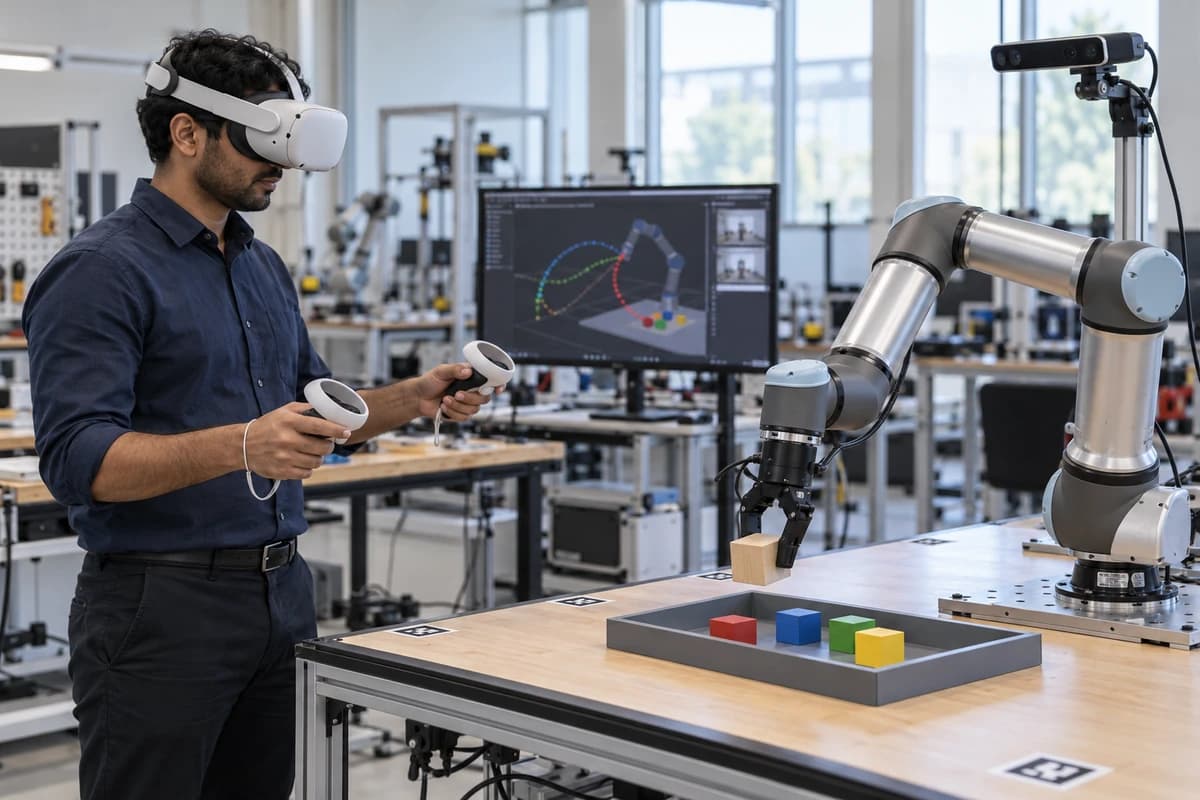
2. Immersive VR Teleoperation: Operator views stereo pass-through video and controls 6-DoF end-effector targets via tracked VR controllers. Ideal for broad workspace reach and mobile manipulation.
3. Wearable Exoskeleton Gloves: High-DoF finger tracking and force-feedback gloves essential for multi-fingered humanoid hand demonstrations.
Microsecond Hardware Synchronization Across Sensors
A major failure mode in training dataset collection is temporal jitter between cameras and robot encoders. If a camera frame logged at t=0.10s is misaligned with a joint angle recorded at t=0.15s, the model learns corrupted dynamics.
Professional capture pipelines deploy Precision Time Protocol (PTP IEEE 1588) and hardware trigger pulses across all camera sensors and microcontrollers, maintaining microsecond-accurate alignment.
Episode Filtering, Labeling, and Quality Assurance
Raw teleoperation contains human imperfections: hesitations, accidental table touches, and recovery re-grasps. Automated and human-in-the-loop QA pipelines parse every demonstration, segmenting sub-tasks (e.g., 'approach', 'grasp', 'lift', 'place') and trimming erratic artifacts.
Commissioning a Custom Enterprise Data Collection Campaign
When existing public or marketplace datasets do not cover your proprietary parts, custom collection campaigns deploy standardized rigs and trained operators into representative test cells, logging thousands of verified demonstration hours tailored to your production workflow.