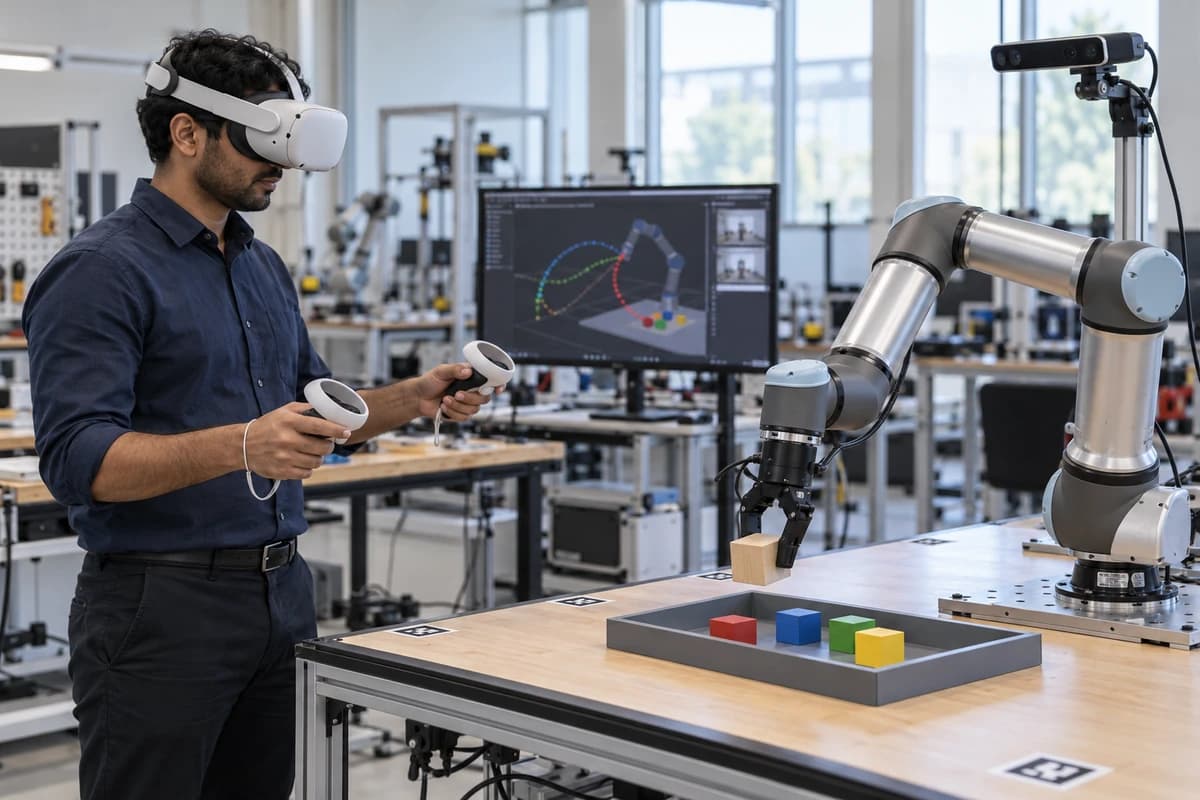


- Generative AI operates in open-loop digital environments; Physical AI requires strict closed-loop real-time execution.
- Physical AI models must abide by physical laws: gravity, friction, thermal limits, and motor torque constraints.
- Safety in Physical AI is deterministic and hardware-enforced (ISO 10218, ISO TS 15066), not probabilistic.
- The primary bottleneck for Physical AI is not compute, but multi-modal real-world sensorimotor training data.
Defining Physical AI: The Embodied Paradigm
Over the past three years, generative AI has transformed how enterprises process digital information—generating code, summarizing contracts, and answering customer queries. Yet these large language models (LLMs) and diffusion systems operate entirely within the digital realm. They receive tokens and emit tokens, insulated from the physical consequences of their output.
Physical AI (also termed Embodied AI) represents the next frontier: artificial intelligence that interacts with, navigates through, and manipulates the real world via robots, autonomous mobile units (AMRs), humanoid systems, and automated machinery.
Generative AI predicts the next most likely token. Physical AI executes the next physically stable, collision-free motor command.
Five Fundamental Differences: Digital vs Physical AI
To understand why building Physical AI systems requires fundamentally distinct engineering disciplines, we must contrast their operating environments across five critical dimensions:
- Latencies and Real-Time Execution: While an LLM latency of 300ms is acceptable for chat, a robotic arm moving at 1.5 m/s requires control loops running at 50Hz to 1kHz (1–20ms). Delayed commands cause overshooting and kinetic collisions.
- Consequences of Hallucination: A hallucinated paragraph in a chatbot requires a human to re-read. A hallucinated trajectory in a 250kg industrial robot can cause severe equipment damage, factory downtime, or human injury.
- Multi-Modal Sensor Modalities: Physical AI models ingest high-frequency IMU telemetry, 3D LiDAR point clouds, 6-axis force-torque sensor data, joint encoders, and depth imagery simultaneously.
- Irreversible Actions: You can undo a git commit or delete a generated image. You cannot un-drop a delicate glass vial or un-collide an AMR with a facility barrier.
- Deterministic Safety Guardrails: Physical AI deployments wrap neural policy networks inside certified safety controllers, emergency stop busses, and kinematic limits.
The Closed-Loop Perception-Action Architecture
Physical AI does not execute open-loop batch predictions. Instead, it operates on a continuous feedback loop: sensing the environment, updating its internal world model, synthesizing a kinematic plan, sending actuator commands, and immediately sensing the tactile and visual consequence.
This closed-loop coupling allows robots to recover from unexpected external disturbances—such as a slippery object shifting in a gripper or an operator stepping into a shared workspace.
Real-World Safety and Inviolable Physics Constraints
In digital software, an edge case yields a 500 status code. In robotics, an edge case encounters physics. Gravitational acceleration, surface friction coefficients, actuator gear backlash, and motor thermal limits cannot be bypassed by scaling model parameters.
Enterprise adoption of Physical AI therefore combines learned neural policies (such as Vision-Language-Action models) with deterministic classical robotics algorithms—ensuring ISO 10218 and ISO TS 15066 compliance on every industrial deployment.
Building an Enterprise Physical AI Strategy
Enterprises seeking to deploy Physical AI should begin by identifying high-frequency, repeatable manual tasks where labor availability is constrained and physical variance is bounded. Conducting an on-site robotics readiness audit ensures that digital twins, cell geometry, and throughput expectations are validated prior to capital expenditure.