

- Humanoids are not meant to replace stationary cobots or AMRs; their value lies in unstructured human-built environments with stairs, narrow doorways, and vertical reach.
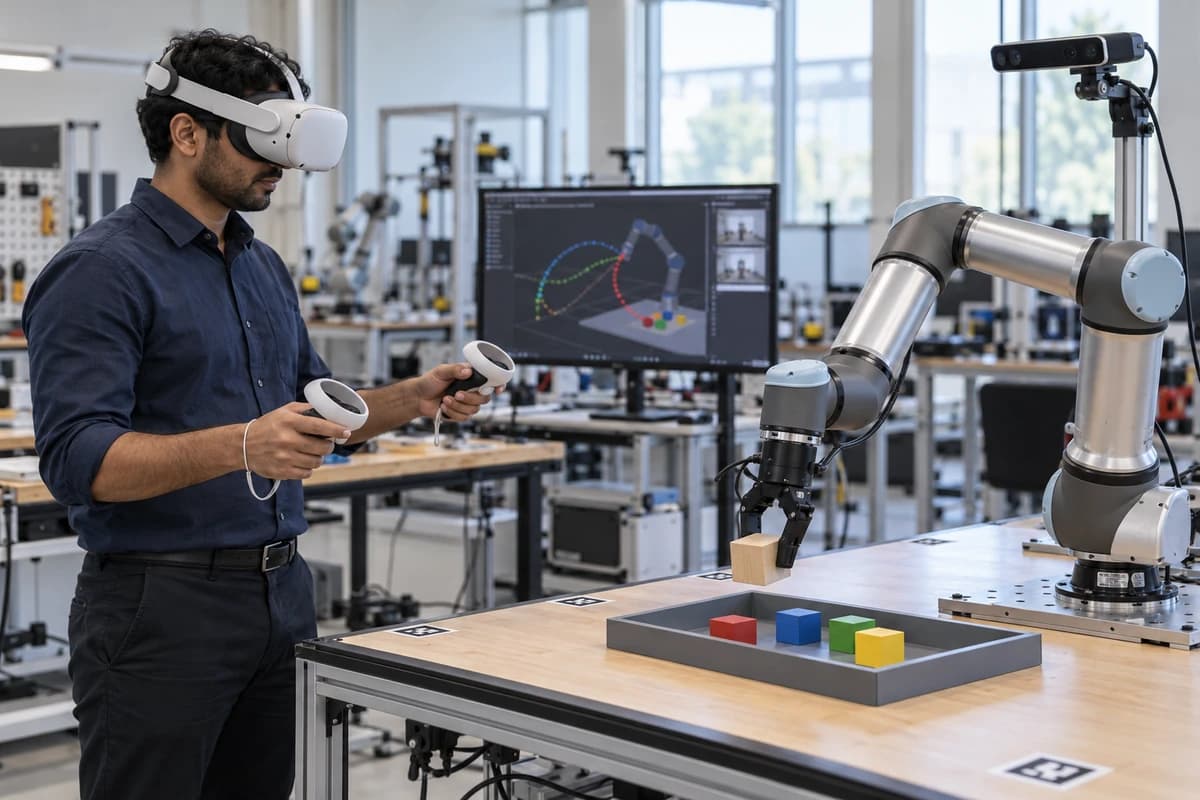
- Early humanoid pilots succeed by starting with teleoperated shadowing, gradually transitioning to autonomous execution as demonstration data accumulates.
- Safety governance must address higher kinetic mass and fall risks with designated containment corridors during initial commissioning.
- Establish quantifiable metrics: Mean Time Between Interventions (MTBI), cycle time repeatability, and battery autonomy.
Humanoid Hype vs. Factory-Floor Reality
Humanoid robotics has captured executive imagination worldwide. However, enterprise deployment must be grounded in operational reality. For 80% of industrial automation tasks, specialized stationary robot arms or wheeled AMRs are cheaper, faster, and safer.
Where humanoid robots truly shine is in brownfield environments designed exclusively for humans: facilities with stairs, tight aisle clearances, multi-level shelf picking, and tasks requiring high vertical reach that wheeled carts cannot access.
Identifying Ideal Tasks for Humanoid Form Factors
High-probability pilot tasks include:
1. Tote and Container Transfer: Moving standardized KLT containers between conveyor drop points and mobile carts.
2. Sequential Machine Loading: Walking between multiple CNC machines, operating doors, and transferring raw billets.
3. Facility Inspection & Dial Reading: Navigating multi-level catwalks and industrial boiler rooms to inspect analog gauges.
Safety Zoning, Containment & Emergency Protocols
Because bipedal robots have high centers of gravity and substantial kinetic mass, early pilot phases require strict safety enclosures and tethered dynamic safety cables to eliminate fall hazards during dynamic balance calibration.
The Teleoperation-to-Autonomy Deployment Cycle
Do not expect day-one zero-shot autonomy. Successful programs deploy humanoids under human teleoperation for the initial 4 to 8 weeks, collecting hundreds of facility-specific demonstrations. Once sufficient domain data is gathered, learned diffusion policies are deployed for autonomous execution.
Defining Clear Pilot Success Metrics & Exit Gates
Before funding an enterprise pilot, establish transparent evaluation criteria:
• Autonomous Task Completion Rate (>95%)
• Mean Time Between Interventions (>60 minutes)
• Cycle time parity with human operators (within 1.5x of human speed)
• Continuous battery endurance and automated docking recharge reliability